Der Löwe xx
Der Löwe xx
- CVM-left C6
- Sex: Male
- Date of Birth: January 1st, 1944
- Date of Death: January 1st, 1974
- View Pedigree (Printable PDF)
- View Relationships
- Sire: WAHNFRIED XX
- Dam: LEHNSHERRIN XX
Breeder: P Mühlens
The Thoroughbred stallion, Der Löwe xx produced 18 approved sons, 23 state premium mares and 183 registered mares as well as 314 registered competition horses which together won a combined prize money of DM 750,086 by 1979, a lot of money at the time.
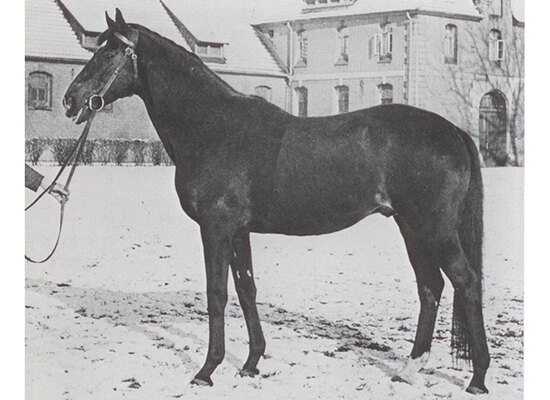
These are the statistics of a Thoroughbred stallion that was laughed at by so-called breeding experts and dismissed as a “bunny rabbit”. But his small stature did not prevent Der Löwe xx from becoming one of ‘the greats’, as Werner Schockemöhle describes him in his book The Great Stallions of Hanover, published in 1988. Not only did he have robust health, he died at the age of 29, but he also possessed great heart and courage, qualities he passed on to his offspring.
However, according to Werner Schockemöhle, circumstances did not look promising for the young colt when he was born in 1944 at the historic Thoroughbred stud Röttgen. Germany was in the midst of War, supplies were scarce and horses did not have high life expectancy.
But the colt by Wahnfried, out of Lehnsherrin (Herold/Lapis Electrix), was lucky, he received extra attention when others didn’t. At the age of 18 months he was transferred to the training stables of Röttgen’s trainer Albert Schlaefke, his toughness and enthusiasm earned him his name Der Löwe, the lion.
Der Löwe won races over 1000, 1600 and 2800 metres, culminating in his best season as a four-year-old in 1948, when he won a classic Group One race in Baden. He showed enormous potential as a stayer winning a 3200m Group Race in Frankfurt. He ran his last race in 1949 with 32 races and 8 wins to his record. Interestingly Werner Schockemöhle remarks that his racing index would not have been good enough to be approved for Thoroughbred mares.
When Der Löwe began his stud duties at Celle state stud, German breeding was in a phase of decline that was to last until 1961. The local rural breeders were not impressed by the small Thoroughbred stallion, and Schockemöhle confirms that the stallion didn’t have the best conformation with a long and deep neck, but balanced this with a long shoulder, good topline and muscle, as well as well-conformed hind legs. Consequently he served only 24 mares in his first season and not much more in the coming years. His foals all carried the Thoroughbred type of their father, regardless of how massive the mare was. All his offspring were characterised by excellent shoulders, good topline, pretty heads and some, with above-average movement.